
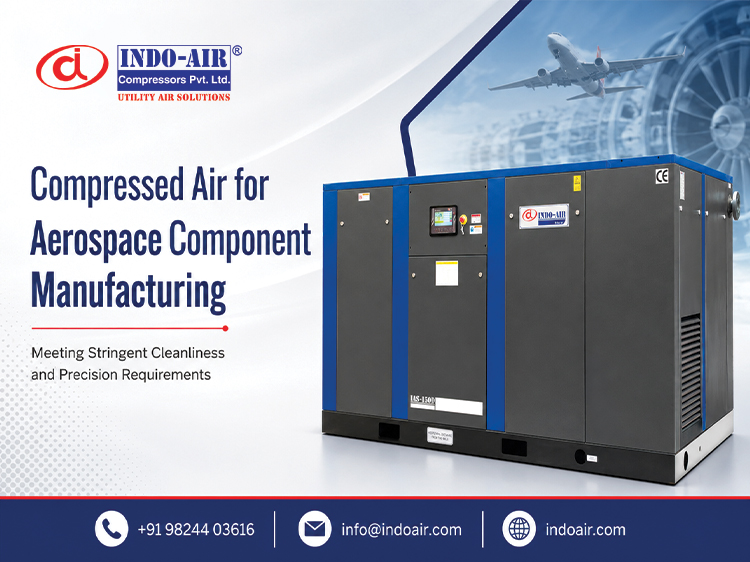
Discover how clean, reliable compressed air supports aerospace component manufacturing by meeting strict purity, cleanliness and precision requirements.
Aerospace component manufacturing stands as a testament to humanity’s ingenuity, pushing the boundaries of engineering to create machinery capable of defying gravity and traversing the vastness of space. However, this pursuit of the extraordinary necessitates an equally extraordinary commitment to precision and cleanliness. Every minuscule component, from the intricate workings of a satellite to the robust structures of an aircraft, must adhere to standards far surpassing those of most other industries. In this exacting environment, compressed air emerges not merely as a utility, but as an indispensable partner, playing a multifaceted role in achieving the stringent cleanliness and precision requirements vital for aerospace success.
The Importance of Cleanliness in Aerospace Component Manufacturing
The phrase “cleanliness is next to godliness” takes on a literal, life-or-death significance within aerospace manufacturing. Contamination, even on a microscopic level, can have catastrophic consequences, compromising the integrity and functionality of critical components.
The Detrimental Effects of Contamination
Even the tiniest speck of dust or the slightest trace of oil can wreak havoc on aerospace components. For example, in hydraulic systems, particulate matter can abrade seals, clog narrow passages, and lead to fluid leakage, ultimately compromising flight control. In electronic assemblies, airborne contaminants can cause short circuits, insulation breakdown, and signal interference, jeopardizing the sophisticated avionics that guide modern aircraft. Furthermore, the presence of even minor contaminants during surface treatment processes, such as painting or coating, can lead to poor adhesion, premature corrosion, and a compromised protective layer. This is particularly critical for components exposed to harsh environmental conditions, where a pristine surface is essential for durability and performance.
Regulatory Standards for Cleanliness
Aerospace manufacturers are bound by a complex web of regulatory standards and industry specifications that dictate permissible levels of contamination. Organizations such as the International Organization for Standardization (ISO) and the Society of Automotive Engineers (SAE) publish detailed guidelines for everything from particulate contamination in cleanrooms to the permissible residue on manufactured parts. Adherence to these standards is not optional; it is a prerequisite for certification and the very ability to supply components to the aerospace industry. Failure to meet these stringent requirements can result in costly recalls, irreparable damage to reputation, and, most importantly, a severe risk to safety.
Precision Requirements in Aerospace Component Manufacturing
Beyond cleanliness, the aerospace industry demands an unparalleled level of precision. Components are often designed with tolerances measured in microns, and any deviation can have cascading effects throughout the entire system.
Micro-Tolerances and Their Impact
The intricate designs of aerospace components often feature extremely tight tolerances. A turbine blade, for instance, must be manufactured to near-perfect dimensions to ensure optimal aerodynamic efficiency and prevent premature fatigue. Even a minute deviation in the shape or weight of a component can alter the balance of a rotating assembly, leading to vibration, noise, and ultimately, structural failure. Similarly, in optical systems for satellites or navigation, the alignment and surface finish of lenses and mirrors must be flawless to guarantee accurate data acquisition and transmission. These micro-tolerances are not just about functionality; they are directly linked to the performance, longevity, and safety of the entire aircraft or spacecraft.
The Role of Precision in System Integration
Aerospace systems are typically composed of thousands, if not millions, of individual components, each manufactured by various suppliers around the globe. For these disparate parts to integrate seamlessly and function as a cohesive whole, an unwavering commitment to precision across the entire supply chain is paramount. Mismatched components can lead to assembly difficulties, increased stress points, and a diminished lifespan of the overall system. The ability of a component to fit perfectly and operate flawlessly within a larger assembly is a direct consequence of the meticulous precision exercised during its manufacturing process.
Achieving Stringent Cleanliness Standards in Aerospace Component Manufacturing
Meeting the rigorous cleanliness standards of the aerospace industry requires a multi-faceted approach, incorporating controlled environments, specialized cleaning processes, and continuous monitoring.
Cleanroom Environments
Many aerospace manufacturing processes, particularly those involving sensitive electronics, optical components, or critical hydraulic systems, are conducted within meticulously controlled cleanroom environments. These specialized facilities are designed to minimize airborne particulate matter, temperature fluctuations, and humidity levels.
Air filtration systems, positive pressure differentials, and strict personnel protocols are employed to prevent contamination from entering the cleanroom and to ensure that the manufacturing process occurs in an impeccably pristine setting. The classification of a cleanroom, such as ISO Class 5 or 7, directly correlates with the maximum allowable number of particles per cubic meter, underscoring the extreme dedication to cleanliness.
Advanced Cleaning Methodologies
Beyond cleanrooms, specialized cleaning methodologies are employed to remove contaminants from components at various stages of production. These methods can range from ultrasonic cleaning with deionized water to solvent degreasing and plasma cleaning.
The choice of cleaning methodology is carefully selected based on the material of the component, the type of contaminant, and the desired level of cleanliness. Each step is rigorously validated to ensure complete removal of foreign substances without damaging the delicate surfaces of the components. Furthermore, the handling of cleaned components is also critical, often involving specialized gloves, vacuum packaging, and controlled storage to prevent recontamination.
The Role of Compressed Air in Aerospace Component Manufacturing
| Metrics | Data |
| Compressed Air Usage | High in aerospace component manufacturing due to its versatility and reliability |
| Energy Efficiency | Important factor in selecting compressed air systems to reduce operational costs |
| Pressure Requirements | Varies based on specific manufacturing processes and equipment |
| Contaminant Control | Critical for maintaining quality and performance of aerospace components |
| Maintenance Frequency | Regular maintenance needed to ensure consistent and reliable compressed air supply |
Within this demanding landscape, compressed air emerges as an unsung hero, playing a critical role in numerous aspects of aerospace component manufacturing, particularly in areas related to cleanliness and process efficiency.
Powering Cleanroom Equipment
Compressed air is an essential utility for powering a wide array of equipment used within cleanroom environments. This includes specialized tools for assembly, material handling systems, and even some automated robotic systems that are designed to operate without human intervention to further minimize contamination risks. The consistent and reliable supply of clean, dry, and oil-free compressed air is crucial for the uninterrupted operation of these critical pieces of equipment, directly supporting the maintenance of the cleanroom’s integrity. Any compromise in air quality could lead to equipment malfunction and subsequent contamination of the manufacturing process.
Precision Cleaning and Drying Applications
Perhaps one of the most critical roles of compressed air in aerospace manufacturing is its application in precision cleaning and drying. After various machining or surface treatment processes, components often require thorough cleaning to remove cutting fluids, debris, or other residues. Compressed air, when properly filtered and dried, is used to blow away loose particles, dry intricate geometries, and ensure that surfaces are completely free of moisture, which can lead to corrosion or interfere with subsequent coating processes. The controlled force and precise directionality of compressed air allow for targeted cleaning in areas that might be inaccessible to other methods, making it invaluable for complex component designs.
Surface Preparation and Coating
Before painting, plating, or applying protective coatings to aerospace components, the surfaces must be impeccably clean and perfectly dry to ensure optimal adhesion and durability. Compressed air is extensively used in this crucial preparatory phase for applications such as air blasting to remove residual scale or rust, and for precisely drying components after washing. The absence of oil, water vapor, and particulate matter in the compressed air is absolutely essential during these processes, as any contamination can compromise the integrity of the coating, leading to premature failure and potentially catastrophic consequences in service.
Ensuring Precision with Compressed Air in Aerospace Component Manufacturing
Beyond cleanliness, compressed air also plays a vital, albeit often indirect, role in maintaining and enhancing precision throughout the manufacturing process.
Actuation and Control Systems
Many automated manufacturing processes in aerospace rely on pneumatic actuation for precise movement and control of machinery. Robots, clamping systems, and specialized jigs often utilize compressed air cylinders and valves to achieve accurate positioning and repetitive movements. The responsiveness and controllability of pneumatic systems contribute significantly to maintaining tight tolerances during machining, assembly, and inspection. The reliability of these pneumatic systems is directly tied to the quality of the compressed air supplied, as contaminants can lead to valve malfunctions, erratic movements, and a loss of precision.
Precision Machining and Finishing
In advanced machining operations, such as high-speed milling or grinding, compressed air is used for a variety of purposes that directly impact precision. It can be employed to cool cutting tools, preventing thermal expansion and distortion of the workpiece. Furthermore, compressed air can be used to clear chips and debris from the cutting zone, ensuring that the tool has an unobstructed path and maintains consistent contact with the material, leading to a smoother finish and more accurate dimensions. In some finishing processes, finely controlled blasts of compressed air can even be used to deburr delicate components without causing damage, a testament to its versatile and precise application.
Quality Control and Inspection
During quality control and inspection, compressed air plays a supporting role in ensuring that components meet their precise specifications. For instance, in non-contact gauging systems, air jets can be used to suspend delicate components, allowing for precise dimensional measurements without the risk of scratching or marring the surface. Additionally, compressed air is often used in leak testing procedures for components such as fuel lines or pressure vessels, where even the smallest leak can have severe consequences. By introducing pressurized air into the component and monitoring for pressure drops, manufacturers can detect minute imperfections that would otherwise go unnoticed, thus upholding the highest standards of precision and safety.
In conclusion, the aerospace industry’s relentless pursuit of perfection in cleanliness and precision is underpinned by a meticulous approach to every facet of manufacturing. Compressed air, often considered a humble utility, proves to be an indispensable tool in this quest. From powering critical cleanroom equipment and facilitating advanced cleaning methodologies to enabling precise actuation and supporting quality control, the quality and reliability of compressed air directly influence the safety, performance, and longevity of the aerospace components that empower our journey to the skies and beyond. The investment in high-quality, oil-free, and meticulously filtered compressed air systems is not merely an operational expenditure; it is an investment in the future of aerospace innovation and the continued success of an industry defined by its commitment to excellence.
FAQs
1. What are the stringent cleanliness requirements in aerospace component manufacturing?
Aerospace components must be free from dust, oil, moisture, particles, and other contaminants.
Even microscopic impurities can affect component performance, safety, and reliability.
Therefore, controlled manufacturing environments and clean compressed air are essential.
2. Why is precision important in aerospace component manufacturing?
Aerospace components require extremely tight tolerances to ensure accurate fit and performance. Even a minor dimensional error can affect aircraft safety, efficiency, or system reliability. Precision manufacturing helps maintain consistent quality and compliance with industry standards.
3. How can aerospace component manufacturers achieve stringent cleanliness standards?
Manufacturers can use controlled environments, effective filtration, and proper cleaning processes. Oil-free, dry, and contaminant-free compressed air also helps protect sensitive components. Regular equipment maintenance and air-quality monitoring ensure consistent cleanliness.
4. What role does compress air play in aerospace component manufacturing?
Compressed air powers pneumatic tools, automation systems, cleaning, and material handling processes. It must be clean, dry, and reliable to prevent contamination during manufacturing.
High-quality compressed air supports efficient production and consistent component quality.
5. How does compressed air ensure precision in aerospace component manufacturing?
Clean and stable compressed air enables accurate operation of pneumatic tools and automated equipment. Consistent pressure helps maintain repeatability and control throughout critical processes. It also prevents moisture and contaminants from affecting precision components.